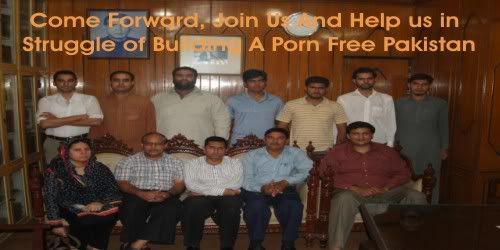
This Group aims to promote solidarity amongst the Pakistani's on the issue of Easy Access to Pornography in Pakistan, as the name itself suggests.

Let there arise out of you a band of people inviting to all that is good, enjoining what is right, and forbidding what is wrong: They are the ones to attain felicity.

Monday, 13 August 2012

No Dance Parties but Dars Allowed, Rules DHA

Two months ago, DHA issued the new set of guidelines on its website and outside its main office listing permissible and prohibited activities.
Mehndis, nikkahs and birthday parties are allowed but musical and dance parties have been banned in what some residents see as DHA’s attempt to morally police its residents. “DHA has no legal authority to issue such a directive,” reacted Asad Kizalbash of the Association of Defence Residents. “Responding to a complaint from a neighbour about too much noise is something different. Issuing a firm directive like this means they are out to teach us morality. This is unacceptable.” The Association of Defence Residents is an umbrella group of half a dozen associations.
The largest one is Defence Society Residents Association with 3,000 members. DHA vigilance staff has been directed to stop events held without permission. In a meeting held with DHA Administrator Brig Aamer Raza a few weeks back, the association registered its protest. “Vigilance staff will be taking the law into their hands if they start peeking into our homes,” pointed out Kizalbash.
There are close to 50,000 tax-paying households in DHA and Cantonment Board Clifton which has its own bylaws on the use of property. Some residents suspect that DHA’s restrictions are an attempt to clamp down on people renting out houses for private events even though there are clear delineations on residential and commercial spaces.
According to resident Nasir Husain, a 1,000 sq yd house will fetch a maximum of Rs100,000 in rent. “Give it for any other purpose and you can earn Rs250,000 a month. Owners are naturally tempted to let all this happen.” He gave the example of a house off Khayaban-e-Rahat being used to record or ‘dharna’ or protest with 30 people. In his brief remarks, a DHA spokesman said residents have to seek permission before arranging any event. “This has been done to address complaints about noise pollution,” he said. DHA has thus restricted the use of loudspeakers to play music but has not said anything about religious congregations.
The DHA neighbourhoods are not close knit like others around Karachi. “When you know your neighbour, you get to learn about each other’s family background and the dislikes,” said one resident. “If loud music, drinking and dancing is an issue, you can simply talk things over. That doesn’t happen here.” The association for residents has realised this problem and is organising meetings to bring residents together.
This would help at least spread the message – which for now was only available on the website and at the DHA office. Residents Farea Khan and Amra Ghazanfar told The Express Tribune that they had no idea that there were restrictions. “Why would they do that?” added Farea.
As for one resident Mehek Ali, the news was met with skepticism: “I don’t see it lasting – no one is going to stick to the ban.”


Courtesy :The Express Tribune

Tuesday, 10 July 2012

Net Cafes – It’s Time to Shutter them Down

It’s a paradox that a country like Pakistan, which was built to practice Islam and was often called ‘Laboratory of Islam’ by its founder, has now fallen a prey to some un-Islamic norms of which net cafes is one of the darkest un-Islamic practice. Net-Cafes that were originally built to provide internet facilities to public in those times when internet was a new phenomenon and was not readily available as is now, has now become an immoral platform corrupting our youth badly.  According to the statistics, Pakistan is one of the top searchers of porn sites and videos, a really shameful fact for an Islamic Republic.
Those unemployed people, who are uneducated, see promising prospects of business in providing cabins in internet cafes. As Muslims it a double-fold sin of providing access of pornography and earning through this dirty business. Though the economic conditions of Pakistan do not leave much choice for the people to choose an earning, which is the most frequent excuse for the net café earners, but we ought to think that our religious values come first, and it is not only a religious issue but a moral one too. No religion or nation allows the blasphemy done to its youth as the net café is doing.
 Most of the net café users are young people, while, mature people seldom goes to a net café. To add evil to this immoral business, the net café holders have introduced cabins and couples use these cabins for dating purposes, not realizing that a hidden camera is capturing their activities, which, the net café owners upload on YouTube and other such site for the so-called entertainment and use these to blackmail the couples.
It’s a high time to think seriously to overcome this immoral disease otherwise it will eat us up as a nation. Our youth is wasting money and values in the net cafes in the dark alleys and it is time to show them the light. They should learn to be a proud nation by saying no to this immoral net café business. Youth is the most flexible entity of a nation easily influenced by changes, if the seed of net café can yield in them why not the hope of getting rid of it. So let’s promise to spread this hope among our youth and shutter the internet cafes down.

By: Sara Waqar

Tuesday, 3 July 2012

Is it necessary to hire an attractive female to boost up your Business?


Islam is the complete code of Life. We should live our lives according to the traditions of Islam. Because Islam is the only religion which provides guidance in very sphere of life weather it is trade, relationships or business. To keep oneself away and protected from devil one needs a protective covering or sheath against evils which ISLAM provides. Bad things appear to be little in their impact in the start but with time bring huge flaws in society’s morality.

I want to put your attention on depravity that is grabing businesses in the form of marketing, promotion tools, attractiveness glamour and other services. Now a day’s people are using females as a tool to grab public attention about their special products regardless of the thing that it is useful for that gender or not just to add more glamour and masala.
For Example: You are promoting Ferrari cars in showroom irrespective of the gender, but it would be a female model with seducing poses makes it appear more unique and expensive. There’re many examples in which same kind of marketing techniques are used thus causing immorality. Why we’re recruiting females as receptionist, in commercials, for bus service or product promotion with attractive look to appeal customers without focusing of that product. I agree with the fact that some organization prefer talented human resource without gender discrimination but most of them follow immoral ways to boost up their selling business. 

Say No To hire an Attractive Tool to Boost Up Your Business
Let's Wage A War Against Immorality In Business Sector
Your favourable comments would be highly appreciable

Tuesday, 24 April 2012

Petition Against ISPs Filed for not Blocking Adult Websites

A petition has been filed in Lahore High Court seeking cancelation of licenses for those internet and broadband service providers who are unable (or reluctant) to block adult websites, despite PTA’s orders.
Kashif Waseem through his counsel Fahad Ahmad Siddiqi has filed the petition. He submits that pornography is one of the internets’ worst crimes against children. Easy availability of obscene material websites on the internet is resulting in increasing number of cases of sexual violence against women.
Siddiqi submitted that the Pakistan Telecommunication Authority (PTA) and the Pakistan Electronic Media Regulatory Authority (PEMRA) had issued a list of 170,000, websites to the Internet Service Providers Association of Pakistan, Wateen Telecom, WorldCall Telecom Limited, LINKdotNET, Wi-Tribe Wireless Broadband Internet Service, Broadband Internet Service Provider, Qubee Pakistan, Mobilink Infinity, COMSATS Internet services, and Pakistan Software Houses Association for directing them to stop providing access to porn sites.
He said none of these companies had complied with the PTA directions. He requested the court to cancel their licenses and direct the IGP to register criminal cases against the respondents.

Saturday, 31 March 2012

Pornography – The Next Epidemic for Pakistan


A recent survey conducted by Nielsen group concluded that the majority Youth of Pakistan are deeply frustrated and feel abandoned by the government. As more and more urban centers of our country, which hold the cream intellect of our nation, get connected to the communication networks the epidemic of Pornography grows.
In light of growing socio-economic pressures & eroding religious and moral values our strength our youth could well be on its way to a Demographical as well as Social/Morale Disaster.
The recent report commissioned by the British Council revealed that an overwhelming majority of young Pakistanis say their country is headed in the wrong direction and only 1 in 10 has confidence in the government. They are now entering a work force in which the lion’s share cannot find jobs, a potentially volatile situation if the government cannot address its concerns.
The despair among the young generation is rooted in the condition of their lives. Only a fifth of those interviewed had permanent full-time jobs. Half said they did not have sufficient skills to enter the workplace. And one in four could not read or write a legacy of the country’s abysmal public education system, in which less than 40 percent of children are enrolled in school which is far below the South Asian average of 58 percent. The study interviewed 1,226 Pakistanis ages 18 to 29, from different backgrounds across the country, in March and April earlier this year.
The combination of this increasing frustration among youth of our country and their growing access to World Wide Web and information unchecked is driving the youth of this country in a disastrous direction. In order to understand the growing epidemic of Pornography we need to consider the following information about this industry which sheds light on the magnitude of this growing problem:
Revenue Statistics on Pornography Industry:
Global Revenue from Pornography Industry
$ 57 Billion Worldwide (Greater than the combined revenues of all the world’s football, baseball and basketball franchises
Pornography Revenue – United States
$ 12 Billion (Exceeds the combined revenue of ABC, CBC & NBC which is 6.2 Billion Dollars)
Adult Video Trade
$ 20 Billion (To give clean fresh drinking water to all the people of this planet you only need $ 8 Billion)
Adult Magazines
$ 7.5 Billion
Cable Pay Per View
$ 2.5 Billion
Pornography Trade on Internet
$2.5 Billion (12% of world wide websites are pornographic)
Pornographic CD ROMS
$ 1.5 Billion
The pornography industry is 1 – 10th of the World’s Oil Industry and let us not forget that oil is used in everything.
Viewership Statistics for Pornography:
World Wide Pornographic Websites
4.2 Million Websites (12% of world wide websites are pornographic)
Pornographic Web-Pages
372 Million WebPages
Daily Pornographic Search Requests (Estimated)
68 Million (25 % of Total search engine requests are to search pornographic websites)
Daily Pornographic E-mails
2.5 Billion
Monthly Pornographic Downloads (Peer 2 Peer)
1.5 Billion (35% of all Downloads)

Gender Statistics on Pornography:
Adults admitting to Internal Pornographic addiction
10 % (These are the ones who are admitting)
Female Vs Male visitors to Pornographic websites
72% Male, 28% Female
The above mentioned statistics are just some of the many that are available, this Information might vary in case of Pakistan due to our different social-economic and cultural condition yet we have to admit this fact that Pornography has started and gained a strong hold in the Pakistani society. There are numerous Public markets in major cities of Pakistan like Karachi, Lahore & Rawalpindi where this heinous trade is taking place.
Apart from this as the Teleco penetration increases and more and more people get access to faster more reliable means to gain information, especially the internet, this epidemic promises to pose a great threat to our society if allowed to go unchecked.
As we can clearly see from the Statistics above that internet has proven to be a huge medium of transfer for this industry therefore measures need to be taken to ensure that Young ones, and Adults alike, do not have open access to such information. Blocking their path is one way, a short one I would say. Real need of the time, for the long run, is the awareness.
We need to educate parents to make sure that they monitor activities of their children while they are using internet or mobile phones. These awareness campaigns should not focus on urban areas only, but those masses in rural regions should be educated as well. Awareness is all we can spread to sustain as a society with moral values. For the purpose, a large scale, government funded and supported by private sector, campaign is severely needed.
Broadband companies need to develop Corporate Social Responsibility campaigns condemning this trade and they need to make sure that they take all measures to stop this process of degeneration from spreading.
The government also has heavy responsibility on it because it is the government which needs to develop policies which can obstruct the trade & sharing of pornography.
Let us not forget that the worth of a civilization is not the tall buildings, roads and the economy they construct but in fact it is their religious belief, their morale values, their civic dealings, arts, culture and their ability to bring up good human beings not animals which are driven by their desires. If we fail to provide the youth of our country a strong religious and morale basis we will only end up raising a generation which is not only frustrated but also ethically and morally lost.

Thursday, 8 March 2012

PARENTS' GUIDE TO THE INFORMATION SUPERHIGHWAY


Very little formal research has been done to understand how information technology affects children of  different ages and when is the “right time” to start various activities. Also, children differ in their development and maturity—so parents should first consider their own child’s emotional development and abilities. But common sense, combined with advice from child development  experts, suggests some age-appropriate guidelines. It is also a new resource to help satisfy a child’s seemingly endless curiosity and find answers to those amazing questions kids constantly come up with. Many of the tips in this section apply to more than one age group. We have placed the tip in the age group where it is first applicable.

Ages Four to Seven:
Children at this age begin to make greater use of computer games and educational products. Older children in this age range, with their parents, may also begin exploring online children's areas. Children learn intuitively and quickly, but at this age they still depend on parents for reading and interpreting directions. Between the ages of four and seven, children begin to form their first friendships, grasp the basics of gender differences, and acquire morally relevant rules and behaviors. This is a good time to begin talking about rules for using the computer and going online. Spend as much time as you can with your child while he or she uses the computer. You and your child should have the same address, so you can oversee his or her mail and discuss correspondence.

Ages Eight to Eleven:
Most children begin to directly encounter and appreciate more fully the potential of online experiences. For example, they can begin to use online encyclopedias to do research and download graphics and photos for school reports. They may correspond via e-mail with faraway relatives and online friends. Be aware of your child's e-mail habits and do not allow correspondence with strangers. Get to know your children's online friends just as you would get to know their friends at school or in the neighborhood. Remember, even in cyberspace, the most vulnerable children are those with low self-esteem. Encourage your children to find friends and interests outside of the Internet. Set clear guidelines as to how much time is spent online. Even if a child's online experience is educational, recreational, and enriching, relating to a machine will never offer the benefits of relating to other people face-to-face.

Ages Eight to Eleven:
Children between the ages of nine and eleven are the most likely victims of child sexual abuse. Make sure that your child is aware that not all "friends" whom he or she meets on the Internet will be well meaning. Teach your child to end any experience online when he or she feels uncomfortable or scared by logging off and telling you or a trusted adult as soon as possible. Discuss the unique aspect of anonymous behavior in cyberspace and what it means for your child and others. Explain to your child that many of the people that he or she will meet on the Internet do not use their real identities. For example, a man may identify himself as a woman, or, in some cases, adults may attempt to pass themselves off as children. Explain that while these actions may seem funny and harmless, many children are often seduced and lured into dangerous situations by such predators. As your child moves toward independence, you need to stay "hands-on" and help guide him or her to appropriate online content. Children of this age are also prime targets for programmers and advertisers. Help your child evaluate content and understand what's behind advertising. Discuss the difference between advertising and educational or entertainment content. Show your child examples of each. Begin to show your child the difference between sources of information that are credible and those that are not.

Ages Twelve to Fourteen:
Adolescents are capable of using the sophisticated research resources of the Internet, accessing everything from library collection of magazines and newspapers to letters and archives from around the world. Just as most teenagers are interested in chatting on the phone, many will want to be involved in chatting online. However, these areas are often the playgrounds of pedophiles, criminals, and unscrupulous marketers who may target your child. Thirteen to fifteen-year-old teenagers are at the greatest risk of sexual exploitation by Internet predators. While you (and your teen!) may feel that he or she doesn't need the same restrictions that are placed on younger children, please consider the risks of allowing your teenager unlimited Internet freedom. This age group is more likely to explore the Internet and reach out to people outside their peer groups, which increases the likelihood of being preyed upon by sexual predators. Parents must set up clear rules for teenagers. This means agreements about Internet access at and away from home, time limits, and periodic check-ins. Help your child understand the laws governing online behavior (including pornography, predators, and stalking) and the consequences to them or anyone else for breaking them. Remind your son or daughter that possession, distribution, and production of some pornographic material is illegal. Ask your teenager very specific questions like: Have you seen any pornographic pictures? Has anyone online talked dirty to you? Have you met anyone online whom you don't know? Has anyone asked you for personal information? Has anyone asked to meet you in person?

Ages Fifteen to Nineteen:
Teenagers often want to have a computer in their bedroom. In spite of a teenager's need for privacy and independence, it is not recommended that a computer with Internet access be placed in his or her bedroom. It's very difficult for a parent to monitor a teen's online activities when the computer is behind a closed door. Some parents have reported seeing a blue glow coming from under their teen's door in the middle of the night. Later when they received their phone bill, they put the puzzle together and discovered unauthorized computer use. When it comes to Internet access, keeping the computer in a common area of the home is the safest option. Older teens can use the Internet to search for information about job opportunities, internships, and colleges or universities. With their increased skills, curiosity, and freedom come more ways to run into undesirable and even dangerous experiences. Parents must find creative ways to stay in touch with their teenage children about online activities.

(Adapted in part from Parents' Guide to the Information Superhighway, The Children's Partnership)

 
Design by Free WordPress Themes | Bloggerized by Lasantha - Premium Blogger Themes | Best Buy Coupons